The light-dark contrast is created when light and dark coloured surfaces lie next to one another.
Cold-warm contrast
The cold-warm contrast is based on how colours are perceived by humans as ‘cold’ and ‘warm’. For instance, red, orange and yellow are warm colours, and blue and green are cold colours
Colour-in-itself contrast
The colour-in-itself contrast occurs when two or more powerful, bright colours are combined with one another. The further the colours are apart from one another on the colour wheel, the higher the contrast.
Quality contrast
Quality contrast is when a bright, vibrant colour meets a less saturated colour, for instance grey.
Quantity contrast
Quantity contrast is the effect of the sizes of colour surfaces compared to one another.
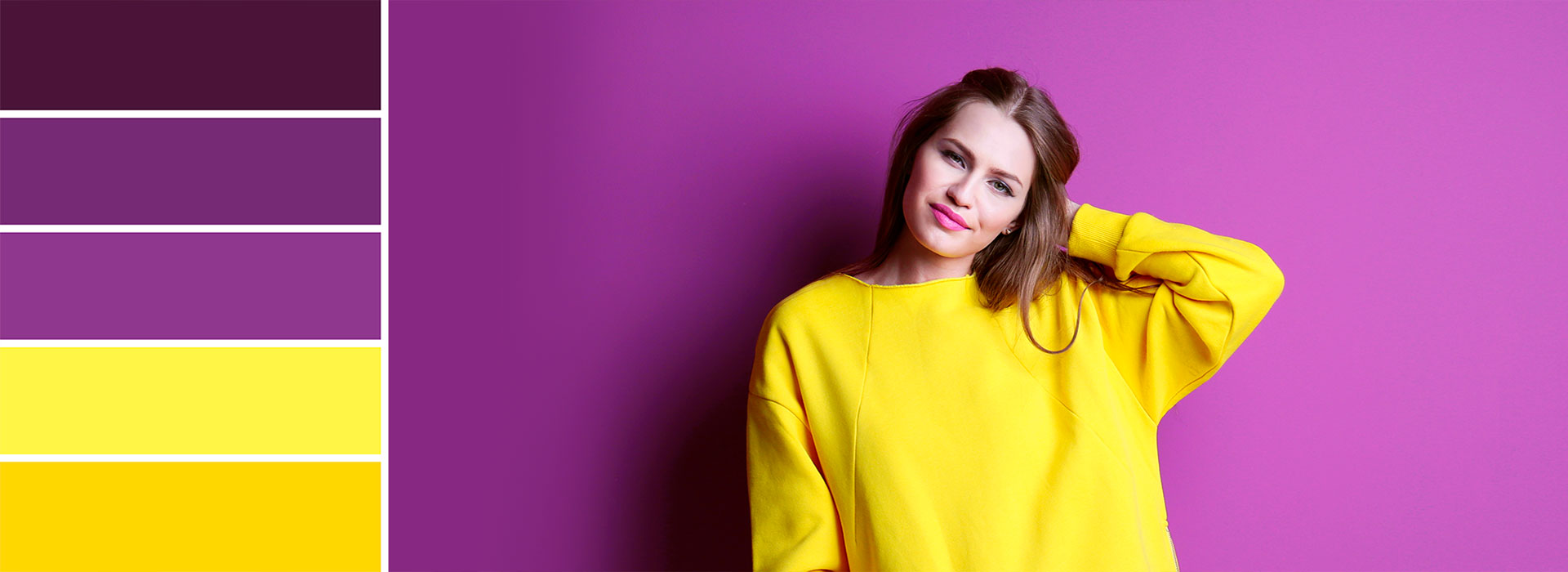
Complementary contrast
Complementary contrast involves combining two colours that are complementary to one another. This means that they lie opposite one another on the colour circle.
Simultaneous contrast
Simultaneous contrast is created when one motif on two adjacent colour surfaces appears in different colour on each surface.

![[Translate to English:] Teaserbild Hell-Dunkel Kontrast](/fileadmin/_processed_/a/9/csm_Teaserbild_Hell-Dunkel-Kontrast_cce057ba23.jpg "[Translate to English:] Teaserbild Hell-Dunkel Kontrast")
![[Translate to English:] Teaserbild Kalt-Warm-Kontrast](/fileadmin/_processed_/e/e/csm_Teaserbild_Kalt-Warm-Kontrast_ec700a97cc.jpg "[Translate to English:] Teaserbild Kalt-Warm-Kontrast")
![[Translate to English:] Teaserbild Farbe-an-sich-Kontrast](/fileadmin/_processed_/b/f/csm_Teaserbild_Farbe-an-sich-Kontrast_46db1ff461.jpg "[Translate to English:] Teaserbild Farbe-an-sich-Kontrast")
![[Translate to English:] Teaserbild Qualitätskontrast](/fileadmin/_processed_/4/d/csm_Teaserbild_Qualitaetskontrast_e3ad0bd1ac.jpg "[Translate to English:] Teaserbild Qualitätskontrast")
![[Translate to English:] Teaserbild Quantitätskontrast](/fileadmin/_processed_/1/3/csm_Teaserbild_Quantitaetskontrast_a4fd7849ff.jpg "[Translate to English:] Teaserbild Quantitätskontrast")
![[Translate to English:] Teaserbild Komplementärkontrast](/fileadmin/_processed_/6/9/csm_Teaserbild_Komplementaerkontrast_c714cfbdcf.jpg "[Translate to English:] Teaserbild Komplementärkontrast")
![[Translate to English:] Teaserbild Simultankontrast](/fileadmin/_processed_/3/6/csm_Teaserbild_Simultankontrast_eb4c3c8624.jpg "[Translate to English:] Teaserbild Simultankontrast")